
Is Your Driveway Ready for Minnesota’s Weather?
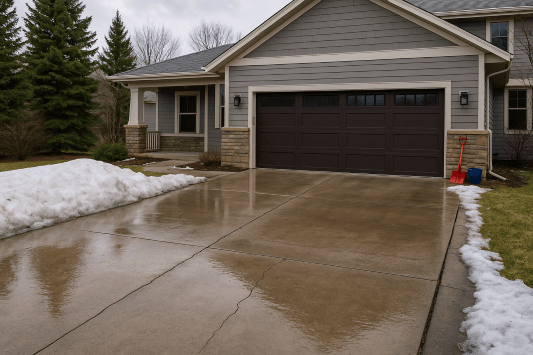
Quick Answer
Yes—your driveway can be ready for Minnesota’s weather with the right materials, base, and sealing plan.
Proper design resists freeze–thaw cycles and deicers. Professional prep and joints reduce cracking and heaving.
If you are planning exterior upgrades alongside deck construction, coordinate elevations and drainage now.
- Choose air‑entrained concrete and a well‑compacted granular base.
- Use control joints and correct thickness for vehicle loads.
- Seal surfaces and avoid harsh deicers during the first winter.
- Improve drainage with slope and downspout extensions.
- Repair early to prevent moisture intrusion and scaling.
5‑Star Google Review
“Patrick Miller visited my home and showed he understood the scope of work that I wanted done. It was a partial reroof of my main house roof. He gave me an estimate that was in the range of other estimates that I received. My intuition told me to hire him. His crew of two workers performed superbly. They worked very hard and had the tear-off and re-shingle work done in a day. They cleaned up the grounds very thoroughly. The roof now looks great and will have many years of service.”
Why driveway readiness matters
Minnesota winters test every surface. Freeze–thaw cycles push water into small voids and joints.
When water expands, concrete and asphalt face stress. Smart planning reduces that stress and extends life.
Patrick Miller Construction designs driveways for our climate. We tailor materials, base prep, joints, and sealers.
We also coordinate adjacent work such as deck construction, stoops, and walkways so drainage performs as one system.
How Minnesota weather affects your driveway
Common issues
- Cracking from freeze–thaw and subbase movement.
- Scaling and spalling from moisture and deicers.
- Heaving where frost penetrates weak, wet subgrade.
- Settling from poor compaction or inadequate base depth.
Pro strategies
- Use air‑entrained mixes and proper slump control.
- Install 4–6 inches of compacted base, often more for clay soils.
- Place control joints at correct spacing and depth.
- Provide 1–2% slope away from the home and garage.
For objective cold‑weather guidance, see the American Concrete Institute resources and MnDOT cold‑climate notes:
American Concrete Institute,
MnDOT Concrete Durability.
Types of driveways that boost value and function

- Broom‑finish concrete: Clean look and dependable traction. Great for most homes.
- Exposed aggregate: Decorative texture with excellent grip and visual depth.
- Stamped concrete: Stone or brick patterns with realistic relief and color.
- Stained or colored concrete: Rich tones and border accents that elevate curb appeal.
- Paver inlays and borders: Mix materials for upscale accents at the apron or edges.
Explore real Twin Cities projects in our gallery.
Materials and specs that withstand winters
- Air‑entrained concrete with proper cement content and water–cement ratio.
- Granular base compacted in lifts with plate compaction or roller.
- Reinforcement where required: steel, fiber, or welded wire mesh.
- Joint layout to manage shrinkage and thermal movement.
- Penetrating silane/siloxane sealers to resist chlorides and moisture.
For planning and comparisons, see the Concrete Network’s driveway guide.
Typical timelines and budget ranges
- Site prep and base work: 1–2 days, weather permitting.
- Forming and pour day: usually 1 day for typical homes.
- Light foot traffic: 24–48 hours after finishing.
- Vehicle traffic: usually after about 7 days.
- Budget ranges: vary by thickness, finish, access, and soil conditions.
We provide clear estimates and options on the
concrete page.
Smart upgrades to pair with your driveway
- Heated aprons near the garage to manage ice sheets.
- Concrete walkways and stoops with matching finish and borders.
- Drainage channels and downspout extensions to move water.
- Low‑glare LED path lighting for safety and style.
- Coordinated deck construction and patio grades for smooth flow.
Driveway FAQs for Minnesota homeowners
Which driveway style balances traction and looks?
Exposed aggregate offers strong grip and a premium, textured look.
How thick should a concrete driveway be?
Four inches is common for passenger vehicles. Heavier loads may need more.
Do deicers harm concrete?
Yes, some do. Use sand first winter. Choose deicer products labeled concrete‑safe.
Can I add borders or paver accents later?
Yes. Plan expansion and color matching. Early design coordination works best.
Can you fix sections instead of replacing everything?
Often. We assess base and drainage to decide between repair and full replacement.
What maintenance keeps concrete looking new?
Clean gently, reseal every 2–3 years, and protect edges during snow removal.
Ready to prepare your driveway for winter and beyond?
Let’s evaluate your surface, base, and drainage. We will suggest the best path to a stronger driveway.
See more work in the gallery,
review options on the concrete page,
and contact us to schedule a consultation.


